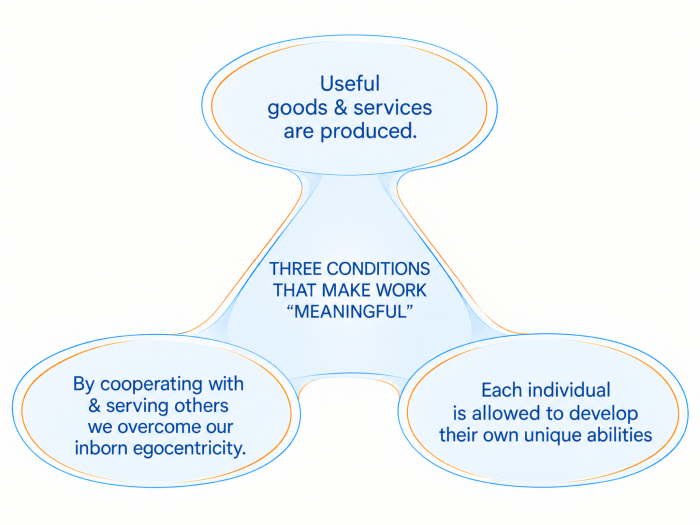
The economist E.F. Schumacher's definition of what constitutes good work has, since I first began writing about education, resonated with me as a useful way of thinking about what makes work meaningful. Everything we do in education, whether as children, students, teachers or administrators, can be thought of as "work". How can we make this work good or meaningful?
A lightly reworded version of the definition of meaningful work in E.F. Schumacher's 1979 book Good Work (publisher: Jonathan Cape)
Schumacher's definition has helped me, over nearly 40 years of teaching in Japanese universities, to develop what I call the Architecture of a Living Curriculum, also referred to as the Living Curriculum Architecture (LCA). The Architecture is a set of principles, not a methodology — principles that hold across contexts, whose particular expression depends on the people, culture and circumstances in which they are applied.
In education most curriculum frameworks describe what should be taught, in what sequence, with what outcomes. They are content frameworks.
This encourages an additive approach to educational change: new content, skills, competencies and values are added while the educational ecosystem into which they are being added remains largely unexamined. The Architecture of a Living Curriculum starts from a different premise: education is an interacting whole, in which whatever is added affects and is affected by what is already there.
At the heart of the architecture is the dignity of each individual. This means not only learners, but teachers, administrators and others working within the educational ecosystem. The same principles will find very different expression depending on the people, purposes and constraints of each particular context.
The framework presented here is therefore based on three prior assumptions:
1) A curriculum is not a list of topics or items to be learned, nor a sequence of content. It is an ecosystem of interacting conditions.
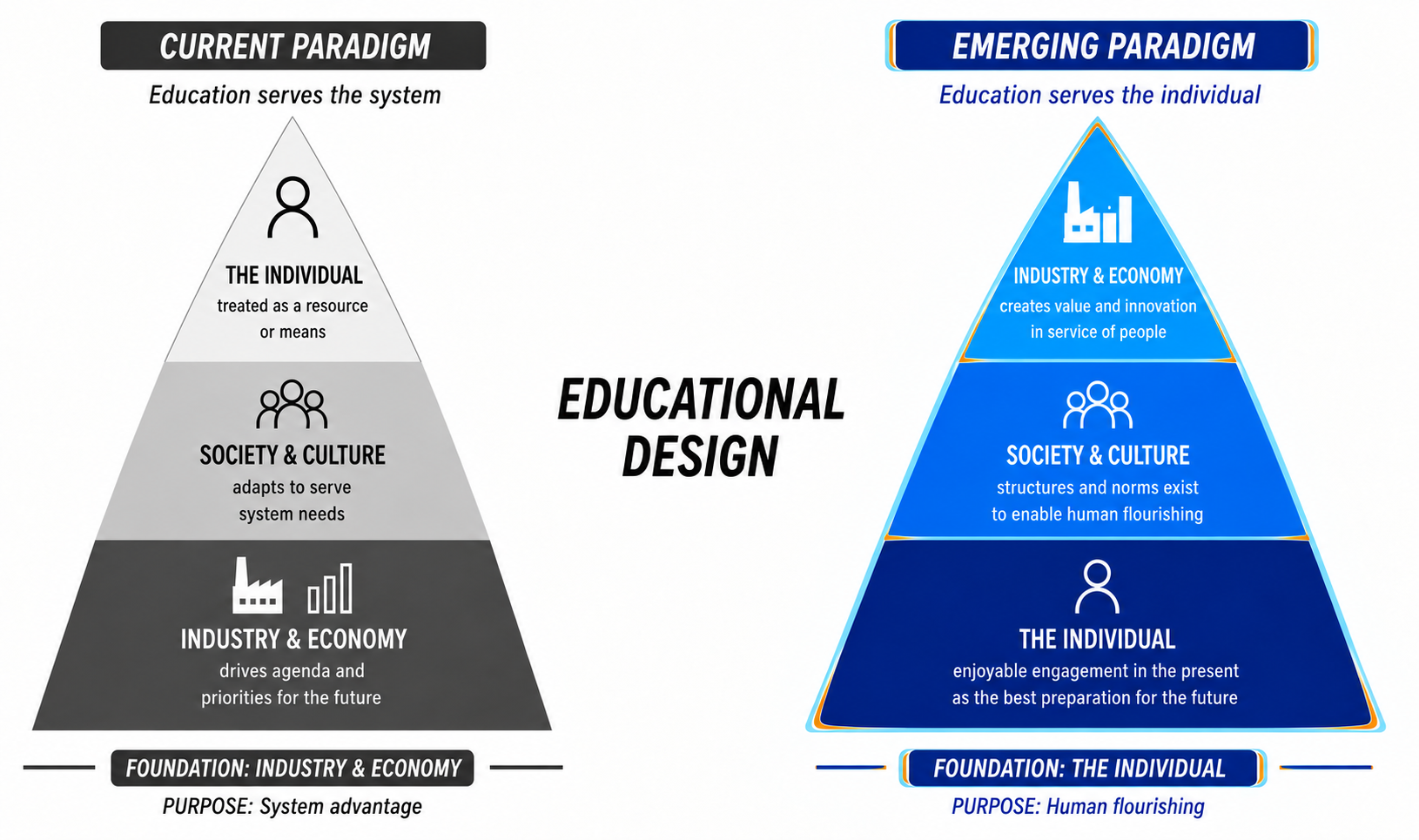
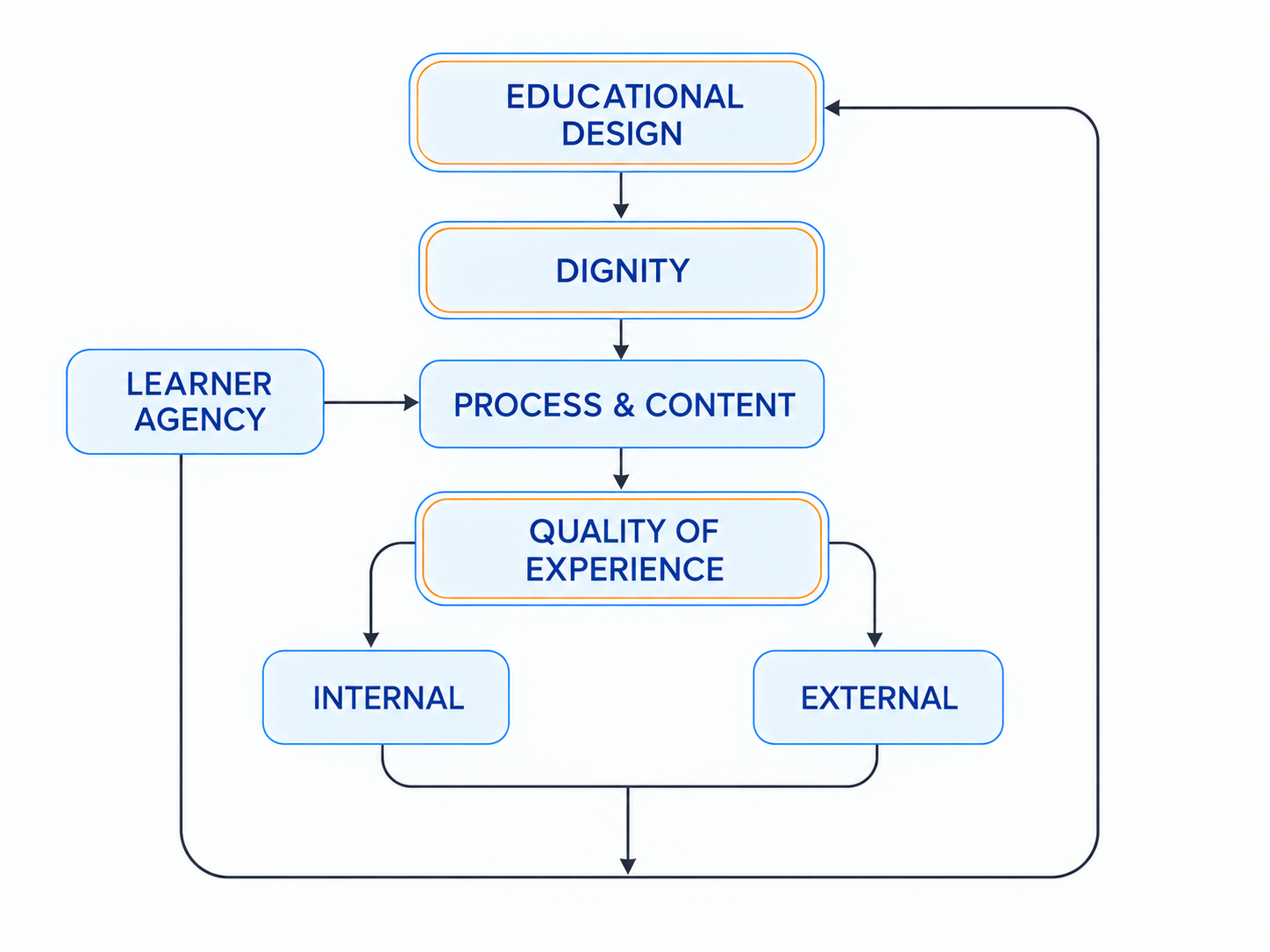
2) My sense is that there is already widespread momentum, not yet obvious, towards a reorientation of education around the unique needs and characteristics of each individual. The diagram below expresses that intuition and the possibilities it opens for educational design.
3) Each educational situation and institution is unique. Weneed new maps and language for developing a shared understanding of what we are doing now and how to facilitate change, not impose it.This page — and the website as a whole — can be seen as just such a map. A map does not tell you where to go. It is not, however, neutral about the terrain. This one makes no prescription about what an institution should teach, in what sequence or under what arrangements; it does commit to an account of what determines the quality of Experience within whatever arrangements are chosen. Used that way, it can show choices that would not otherwise be visible.
Living Curriculum Architecture (LCA)
The Quality of individual Experience
Placingthe quality of individual Experience at the centre of a model of education has this implication:
The purpose of education is to support each individual in enjoying life in the present and growing in their ability to uniquely contribute to the well-being of the people and world around them.
The claim is simple. Its consequences for how educational systems can address the complex problems of our world are not. Notice the emphasis here on the present. We are used to thinking of education as preparation for the future. Of course this will also be the case, but the thesis here is that the future is best prepared for by enjoyable engagement in the present. The implicit definition of intelligence here is far from our notion of IQ and even the more recent embrace by the academy of "multiple intelligences." Intelligence, in this sense, is the capacity to keep growing as a person. The growth is towards enjoying and appreciating life in the present, and towards not being stunted by difficulties, mistakes and disappointments. It is towards becoming ever more conscious of what is going on within and around oneself, and towards recognising oneself in and through other people.
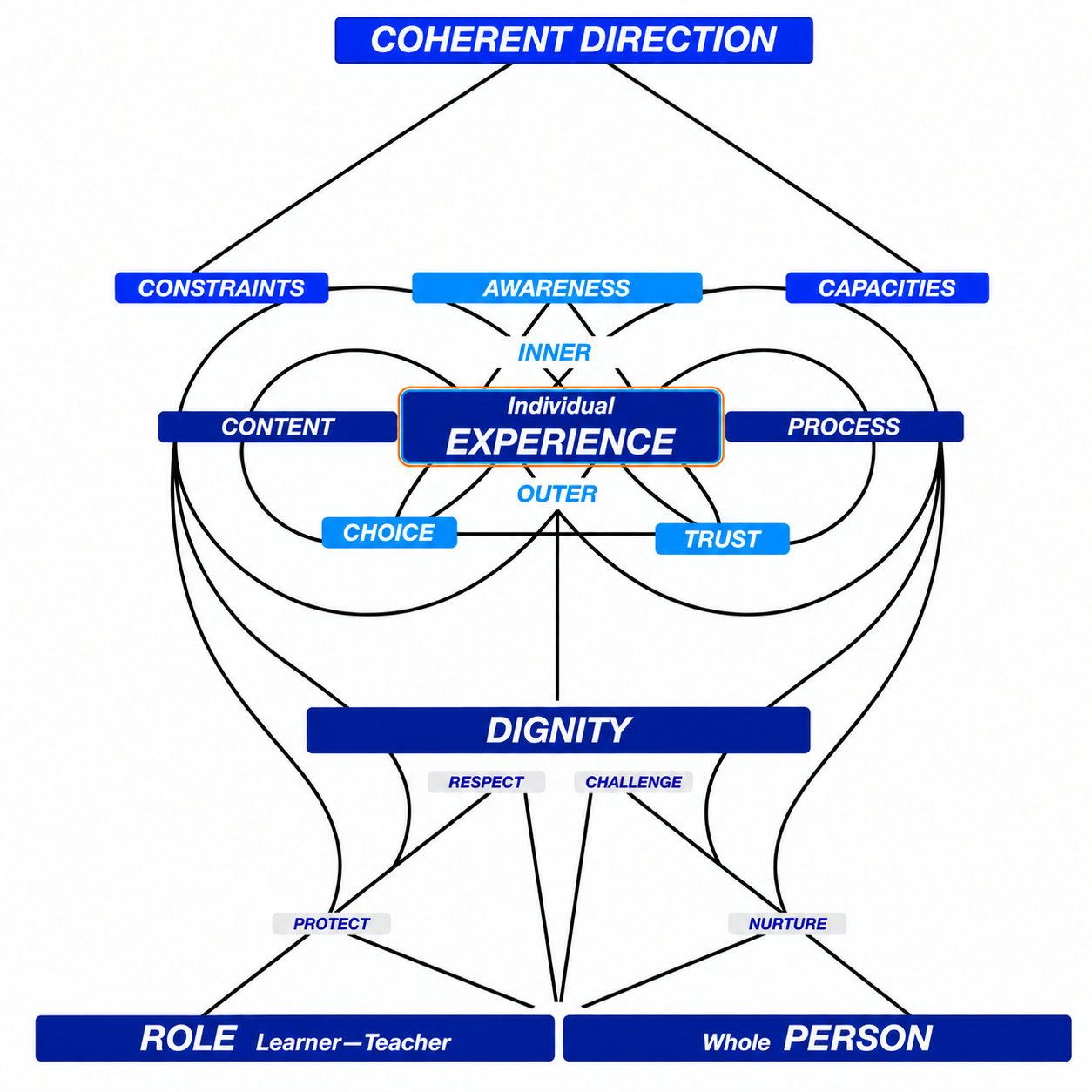
This architecture illuminates the quality — good or bad — of individual Experience as emerging from the interaction of four inseparable dimensions:
Process, Content and Experience
Awareness, Choice and Trust
Coherent Direction, Capacities and Constraints
Dignity, Whole Person and Role
The architecture is triadic at every level — each dimension consists of three interacting elements, and their relationships determine the structure of the whole.
Process, Content and Experience
Process and Content form the visible side of this dimension. Experience is how their interaction is lived. What we remember from our schooling tends not to be the content. We often say we have forgotten everything we studied, but we remember the feelings we had in those classes. The feelings come from the process: what we had to do, how we were treated while we did it, what we came to feel about ourselves — much of it unconsciously. Content fades; the process remains woven into our life experience.
In current mainstream educational design, content is treated as the substance of education and process is subordinated to it — a means of delivering the content. This hierarchy is not accidental. It reflects the same prioritisation shown in the first diagram on this page: an educational system organised around external priorities rather than around the individual. Content can be transmitted, measured and certified; process is slower and harder to specify. So process is subordinated, even though it is the process that has the deepest, most enduring and often least visible impact on who we become.
In lived terms the hierarchy is reversed. An education that designs only its content is designing the part that is destined to be largely forgotten. Even in professional training — medicine, law, engineering — we might assume that everything has to be remembered. It does not. The processes the trainees have gone through leave them able to retrieve what they do not remember when they need it, and to act on it with judgement.
The response is not to invert the hierarchy a second time. In design the two are of equal standing, and in the learner's experience they are not separable at all: what a student is asked to do and what a student is asked to learn arrive as one thing.
When I am asked to explain this distinction, I often refer to a year of history classes I sat through as a boy. I was sixteen, preparing for an important set of exams in the UK. The teacher had a reputation for being highly effective and his method consisted of giving us dictation for around thirty minutes of every forty-minute lesson — we wrote down his notes word for word as he dictated them. For the remaining ten or fifteen minutes he would speak more freely, often saying things like "the mark of a mature boy is being able to make notes on his notes." He frequently quizzed us on the dictation and grew angry when we could not answer.
The process was teaching passivity and fear of getting things wrong. The content asked for independent thought and intellectual maturity. The two were working against each other. The incoherence was not in the students. It was in the design.
When process and content pull in conflicting directions, the result is a system undermining what it is intended to achieve. It is not moving in a coherent direction.
Awareness, Choice and Trust (ACT)
Awareness, Choice and Trust are the locus of self-transformation within the individual. In the diagram they sit close to Experience, while Process and Content form the interface through which the individual engages with the system. Together they allow us to think about agency — how the individual acts or participates within the system. Agency is implied in the acronym ACT itself.
This ACT framework draws on Timothy Gallwey's work, which developed from tennis coaching and was later applied to corporate thinking. Gallwey explicitly emphasised the inner dimension of each of these interacting principles as a key to improving outer performance. ACT is articulated here with a slightly different emphasis: the simultaneous interaction of Inner and Outer. Since educational design is concerned with shaping the conditions within which individuals act, the ACT triad needs to be understood as operating on both levels at once.
Awareness is of both oneself and the situation: what is going on, what the environment consists of, how one is responding. Choice is the conscious exercise of agency rather than passive reaction. Trust, in the sense in which the word is used here, is not trust in the everyday relational sense but something closer to a fundamental sense of the value of one's own existence — one that requires quietening the self-critical voice that monitors and judges performance, and acting from a more direct engagement with the work itself, independent of the judgement of others. It is the point at which Awareness, Choice and Trust connect most directly to Dignity.
These three conditions do not operate in sequence. A shift in any one of them can move all three at once. Their interaction is dynamic and multidimensional. ACT can even be applied as an analytical tool to the system itself: in what senses is it aware of itself, what choices does it make possible for itself and to what extent does it trust the individual or collective participants in the system to act autonomously in the interests of the system and without coercion?
Coherent Direction, Capacities and Constraints
The discussion of Process and Content illustrated the need for Coherent Direction at a local systemic level — the example showed Process and Content pulling against each other. Coherent Direction also operates at larger systemic scales, and at every scale it works in relation to two other terms that were implicit in that discussion: Capacities and Constraints.
Every individual brings capacities to their participation in the system and operates within their own personal constraints and those of the system. Every institution reflects both capacities and constraints in the environment it provides.
The three terms — Capacities, Constraints and Coherent Direction — are only intelligible in relation to each other: capacity is meaningful only against the constraints and direction in play. Constraint depends on what is being attempted. Direction without capacity or constraint is empty.
Dignity, Whole Person and Role
In this framework Dignity is not an ethical aspiration added to an otherwise functional system — it is a constitutive condition. When Dignity is treated as an external ethical layer rather than a foundational condition — as something added to the system rather than built into it — participation easily becomes compliance or withdrawal, and learning tends to be weakened and distorted.
An abstract definition of dignity is deliberately not offered here. What it means to be a human being is the same order of question. The work of answering it belongs to the lived examples and accounts that make up the rest of this site.
Rather than define dignity here, we will say this:
A system that treats people with dignity sees them as whole and unique individuals. It does not require them to internalise the system's priorities as their own. Coercion — visible or invisible, externally imposed or self-imposed — has no place in such a system. Dignity invites conscious attention to Choice. It is related to individual and collective peace. It is assumed to be common ground for human beings, regardless of religion.
The centrality in this model of the dignity of the individual does not imply that teachers and institutions do not already strive to treat students with dignity. Rather, the model invites questions about the ways in which an educational curriculum or system currently treats students and everyone else in it with dignity and about how this dignity can be expressed more coherently and consistently.
Dignity holds a productive tension at the heart of every educational encounter — the tension between the person as a Role (a learner, a teacher, a function within the system) and the person as a Whole Person with history, intelligence, curiosity, resistance and a life that exceeds the role. Both are real. Neither can be dismissed. A system that treats people with dignity does not collapse one into the other. It holds them in productive relation, refusing to reduce the whole person to the role while still acknowledging that the role has its own legitimate demands.
Dignity operates through four interrelated elements that mediate the role/whole-person tension:
Respect — the learner is engaged as a whole person, not a function.
Protect — the system is designed so that learners do not have to pretend to be other than what they are or to know what they do not.
Challenge — the learner is stretched beyond current limits.
Nurture — the learner is supported in sustaining the effort that challenge requires.
A triad needs to be thought of here as two opposing demands reconciled by a third condition. Dignity functions in this way twice: reconciling Respect and Protect in one triad, Challenge and Nurture in the other.
Respect, alone, can tip into demand — the learner is engaged as a full participant in every encounter, including those in which they cannot yet meet the terms being assumed. Protect, as it is defined here, is the system's commitment that the learner is not required to pretend to be other than what they are or to know what they do not. Taken alone, Protect can become over-cautious — so committed to never requiring the learner to pretend that it stops asking anything of them at all. Dignity holds the two together: engagement is real, and the terms on which the learner participates are honest.
Challenge and Nurture form a second triad with Dignity. Challenge without Nurture becomes pressure; Nurture without Challenge invites a complacent reluctance to self-transform. Dignity holds the two together: the learner is stretched in ways that honour what they are and is also supported in sustaining the effort that growth requires.
The two pairs are close enough that they do not quite stand as fully separate triads. The diagram captures this: Dignity does not sit above two separate triads but holds a fourfold structure as two pairs. Challenge and Nurture primarily address growth and change; Respect and Protect address how the learner is received and held in the present. These are different facets of the same tension.
These are not separate components. It is their relationship — not any one element in isolation — that determines the quality of the environment and, through it, the quality of Experience of each individual participating in it.
Living curriculum design responds to and learns from learner participation in a constantly ongoing and adaptive process.
Dignity and Quality of Individual Experience at the Heart of Living Curriculum Design
Most curriculum frameworks describe solely what should be taught and how. In a livingcurriculum, the conditions under which individuals can enjoy being themselves and develop their own unique strengths are cultivated. Learner input is itself part of the curriculum and has an ongoing impact on its design.