On Triads and Their Place in Educational Design
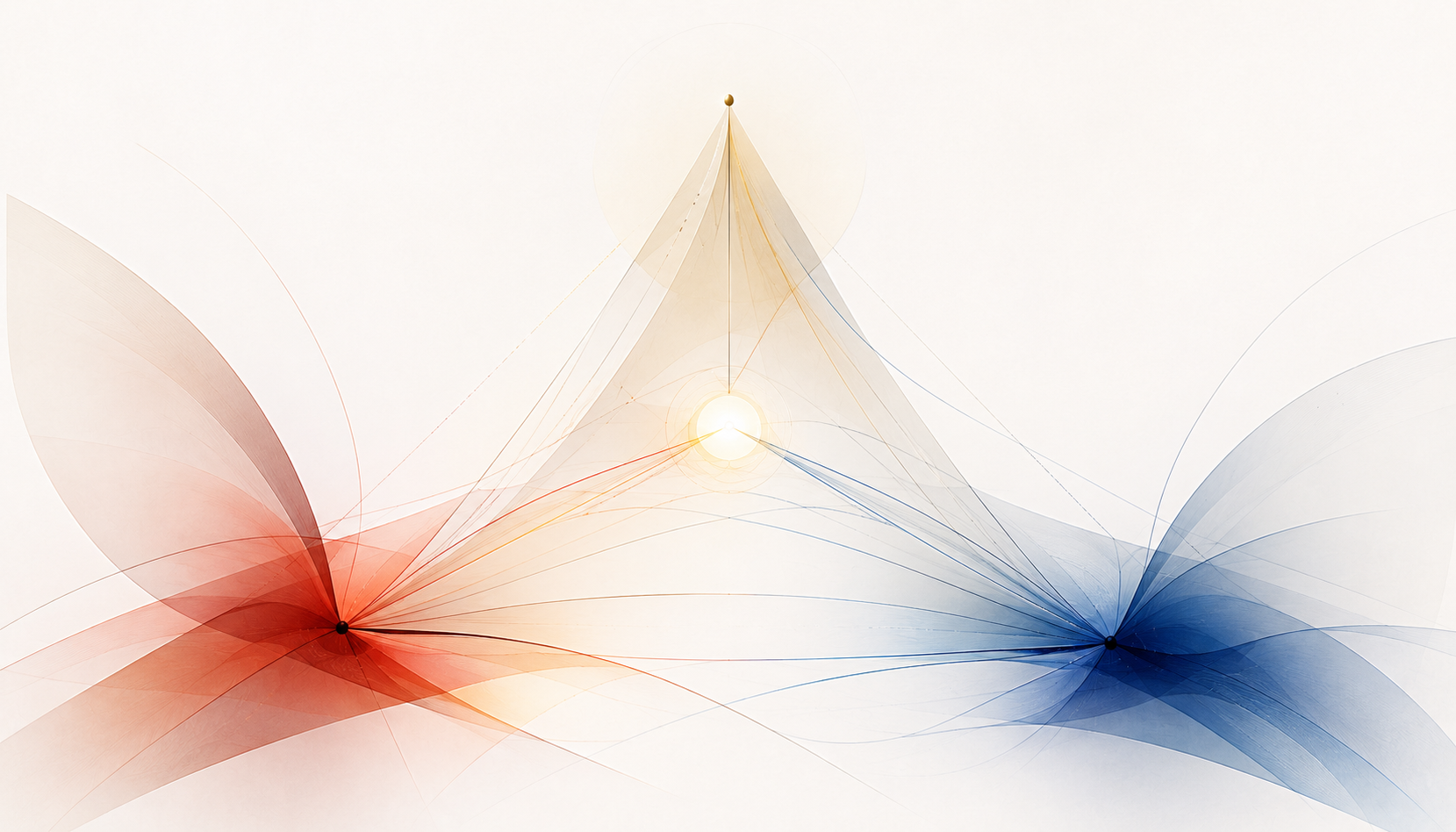
Triads recur in thinking about complexity, design, and human systems. Are they doing real structural work, or are they merely decorative? I've had to ask this question of myself, since the architecture is built from triads. A decorative triad helps you remember three connected things. A structural triad does actual design work — it holds a relation that would otherwise come apart.
A few sources help locate what kinds of work triads can do.
Triangulation is ancient. Navigators and surveyors have used it for millennia: two known points are used to locate a third unknown one. Eratosthenes used something close to it to estimate the Earth's circumference in the 3rd century BCE. Celestial navigation used stars, horizon, and time to fix a ship's position. Feynman brought the same logic into physics as a method of inference — using what is known to reach what isn't. Nick Milo develops it for note-making and sense-making: two known points illuminate a third.
Morin describes reciprocal complexity:
We can conceive organised complex unity only in the form of a trinitarian macro-concept… There is thus a circular reciprocity between these three terms: interrelation, organisation, system.
— Edgar Morin, La Méthode I: La Nature de la nature (Seuil, 1977)
Interrelation, organisation, and system do not stand in sequence. Each generates and transforms the others.
Buckminster Fuller points to structural stability: a triangle holds its shape because its sides hold one another in relation. It is not a list; it is force-bearing. Fuller's trim tab — a small adjustable surface on a ship's rudder or an aircraft's control surface that moves the larger surface — captures the same understanding: a small structural element, rightly placed, does disproportionate work. He had "Call me Trimtab" inscribed on his gravestone.
Three different uses of triadic structure, then:
- Triangulation as a way of locating the unknown from what is known — in navigation, in physics, in note-making
- Reciprocal patterning of three terms that generate and transform one another (Morin)
- Structural stability of triangular relations (Fuller)
The Living Curriculum Architecture uses triadic structure for something different again. It is a design for a humane educational system that takes full account of the complexity of human beings working together for the purpose of learning and growing. That involves identifying recurring systemic problems — tensions that show up across scales, from one-to-one teaching to institutional development — and finding the structural conditions under which those tensions can be lived productively rather than destructively.
Left as a dyad, a recurring tension tends to resolve in one of three ways: opposition (the two terms fight), hierarchy (one is subordinated to the other), or drift (the tension is unmanaged and the system slides). This is a useful diagnostic in its own right — many of the problems we recognise in schools and curricula can be read as dyads resolved in one of these three ways.
The design question is what third term lets a tension become productive — what holds the relation so that the system runs on the tension in a direction that supports the growth and well-being of the system's participants.
In the LCA, that third term is not added alongside the other two as an equal-status item. It works as the locus (or apex) of the relation — the term in which the relation registers and through which it is held in productive form. The locus is not a third item on a list. To treat it as one is to read the triad as three equivalent parts and lose what the third term is structurally doing.
The architecture is triadic in its underlying logic, though not every dimension takes the same surface form. Three dimensions are organised as clear triads; Dignity has a more nested structure, holding the primary tension between Role and Whole Person while also organising the Respect/Protect and Challenge/Nurture pairs as internal triadic relations.
- In Process — Content — Individual Experience, process and content can pull against each other. A history teacher whose method was thirty minutes of dictation per lesson, followed by quizzing, was teaching passivity through his process while his stated content — independent intellectual maturity — required exactly the opposite. The process and the content were undermining each other. Individual Experience is the locus in which process and content become lived together, and in which their relation can be reconstituted.
- In Awareness — Choice — Trust (ACT), the architecture articulates agency. Awareness without choice becomes paralysis; choice without awareness becomes reactivity. Trust moderates the relation so that agency and self-transformation become possible.
- In Capacity — Constraint — Coherent Direction (CCCD), capacity without constraint diffuses; constraint without capacity coerces. Coherent Direction turns the relation into viable and desirable movement.
- In Dignity, the fundamental tension is between Role and Whole Person. A learner, teacher, or other participant always occupies a role within a system, but also lives beyond that role as a whole person with history, intelligence, emotion, vulnerability, resistance, and possibility. Dignity holds that relation. Respect and Protect, Challenge and Nurture then work as nested pairs, also mediated by Dignity, allowing the person to inhabit a role without being reduced to it.
One qualification. The triadic structure described here is a property of the architecture as a designed instrument, not a claim about how lived activity is actually organised. Life is more subtle than any model can capture. As Bateson reminded us, the map is not the territory. What an architecture can offer is a way of attending to what is structurally at stake — a topography of recurring systemic problems and the design conditions under which they can be lived well.
This is why triads in the architecture are not decorative. Not because three is magically better than two, but because a designed triad — a locus holding a relation — helps make human complexity designable without reducing it.