Standards of Excellence

When I was 13 or 14, my next-door neighbour and I designed an obstacle course across our two gardens. We marked out a course of interesting obstacles that required running, jumping, crawling, sliding along the top of the fence that separated our gardens before dropping down and reaching the finish line. We timed ourselves. Then we tried to beat our own times.
Nobody set it up for us. Nobody asked us to improve. Nobody told us what standards to reach for.
⁂
Each summer term the PE teachers ran what they called "Standards." We were measured for our performance in different field and track events. Standard 1 was the higher level. Standard 2 was below that, and "no standard" felt like "you're hopeless at this." The teachers never said so of course.
When it came to the 440 yards I was giving my best, not expecting to reach Standard 2. As I approached the finish line the boys gathered around the teacher with the stopwatch were cheering me on loudly. I wasn't used to that. I didn't quite believe it. I don't remember whether this unaccustomed encouragement gave me extra energy, but I was certainly giving everything I had.
I was just short of the higher standard. That surprised me. I had assumed I was struggling to reach any standard at all.
⁂
I discovered at the age of twelve that I was quite good at table tennis. One summer in Nice, in France, I had a chance to spend time with some US sailors who were on leave from their ship and hanging out at the USO — an organisation that set up recreational opportunities for servicemen. Playing with these grown men, I could more than hold my own. On vacation in the States, our host played with me and said I had the potential to be a table tennis ace. There was no table tennis team at my school.
I was also good at tennis, but tennis was a summer sport at Hampton. By the time I reached the third year, when it became an option, I had signed up for the year-round activities of the boat club. I wanted to try something new.
I was not considered strong enough physically to be groomed for the faster boats. But being fairly lightweight, I was given the opportunity to become a cox. At sixteen I found myself coxing the school's first eight — an unusual position for someone my age.
We spent a week at rowing camp. The facilities included tennis courts and table tennis tables. I was better than every one of my teammates at both. I was proud to be wearing the badge of membership in the school first eight, but there was no badge for what I was actually good at.
Although being cox did take some skill, what it really meant for me was that I was the weakest member of the crew physically. I put up with a lot of teasing. I remember our top rower asking me once as we rode together on a bus to the boathouse, "What's it like to be a little man, Kevin?" I don't remember how I responded. In 2008, during the financial crisis, I read about him in the American press. He had been dubbed "the oil god of Wall Street."
⁂
Something else I found I was good at, around the age of ten, was not a recognised sport at all. The teacher would have us lie on mats — music playing — and we were asked to simply move. There was no instruction about how to stretch or what positions to take. We invented them ourselves. I found I could do things with my body that felt interesting and unusual, and I enjoyed these discoveries.
When parents' day came, we were to demonstrate this activity in front of the parents. The teacher arranged us in rows. I was placed in the front.
The children at the back had been told something too, but not out loud.
⁂
When I was around 15 the headmaster came to speak to our class. We stood, as we always did when he entered — he was the only person for whom we did this. He sat, placed his mortar board on the desk, and explained that he had a project for us. He handed out notebooks. We were to keep a record of our reading, reflect and make notes. He would look at these notebooks regularly.
I tried. But I didn't know what he wanted, and knowing he would inspect what I wrote made it harder, not easier, to write anything true. I felt guilty. We did hand in the notebooks a couple of times, but the project quietly fizzled out. There was no formal ending — no acknowledgement that it hadn't worked, no explanation of why it had stopped.
⁂
I came across an account of his job interview for the school at which he taught before he became the headmaster at Hampton. He was asked what he would do if a boy threw an inkpot at him. His answer was: "It is inconceivable that a boy would ever throw an inkpot at me."
As a student he had been captain of the London University cross-country team. He knew how to exercise self-control.
During the six years we overlapped at Hampton he never once spoke to me personally. Our only exchanges were when he came into the classroom and asked which language option I wanted. "Spanish, sir." And whenever the crew won a regatta event we would troop onto the stage in morning assembly and shake his hand — with me being the last one. That was it.
On his last day in the school he told us in morning assembly that he would be standing in the hallway afterwards so that any boy who wanted to speak to him could do so. I walked past, feeling guilty as I did so.
⁂
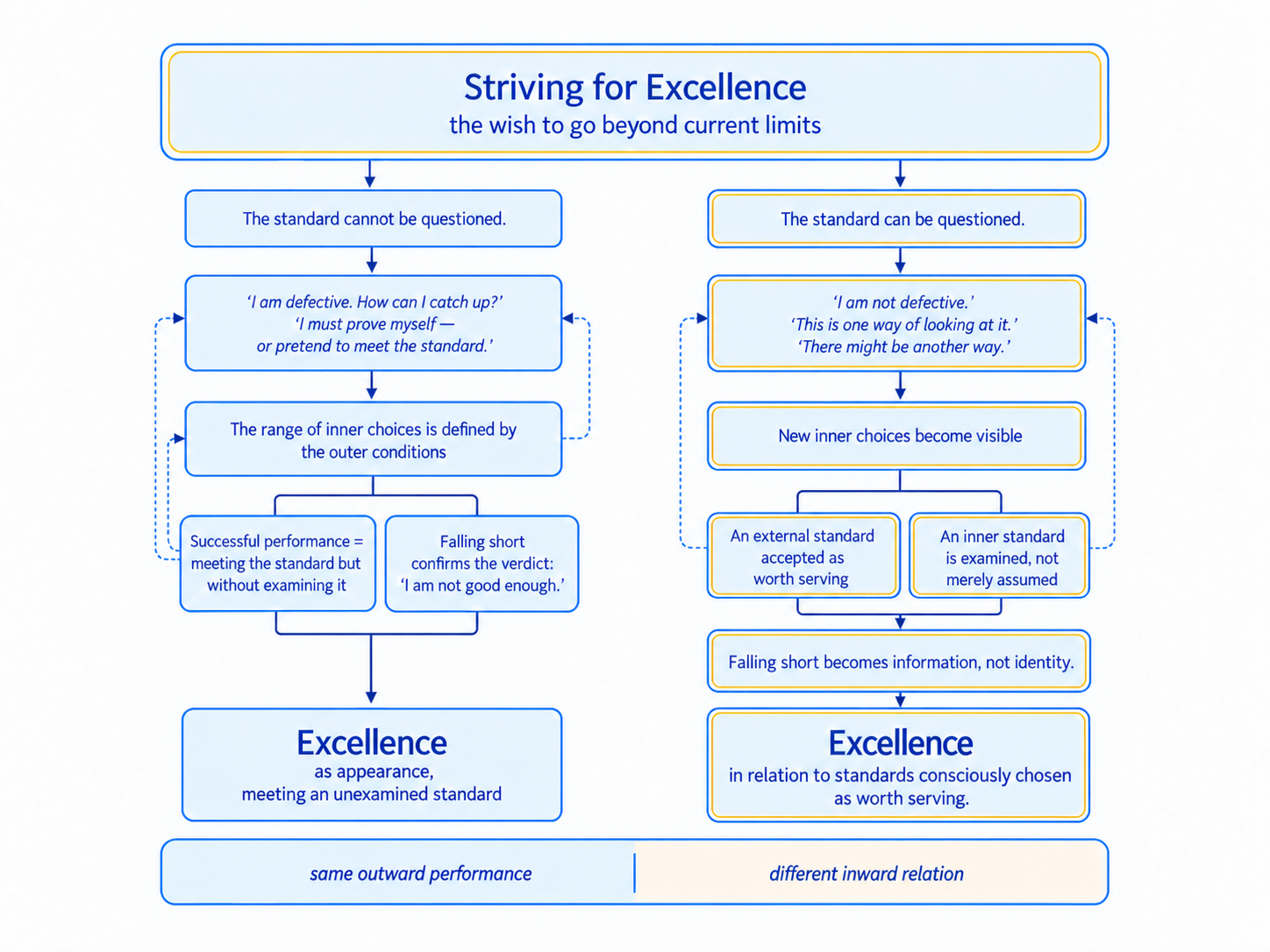
There is a thread running through all of these stories that the diagram below expresses.