
Noticing That We Are Noticing
I had spent the previous two years in Oxford doing agency work — teaching English and French in tutorial colleges, and taking on language-school work in the summer. Self-employed, farming my time out across different agencies. I had a sense that I should be doing something else, but I did not know what.
The English gentleman, who later became a close friend, was the reason the call had happened at all. The professor had asked him to recommend someone for a job in the Faculty of Education. He had remembered our phone conversation from two years before, and my name had come to his mind immediately. He told me later that at the moment he was asked to recommend someone, he had felt a kind of rush of energy and did not hesitate to recommend me, even though he did not actually know me personally — we had only spoken on the phone. When I arrived in April 1985, he was incredibly generous with his time in helping me get used to life in Japan, and we became very close friends.
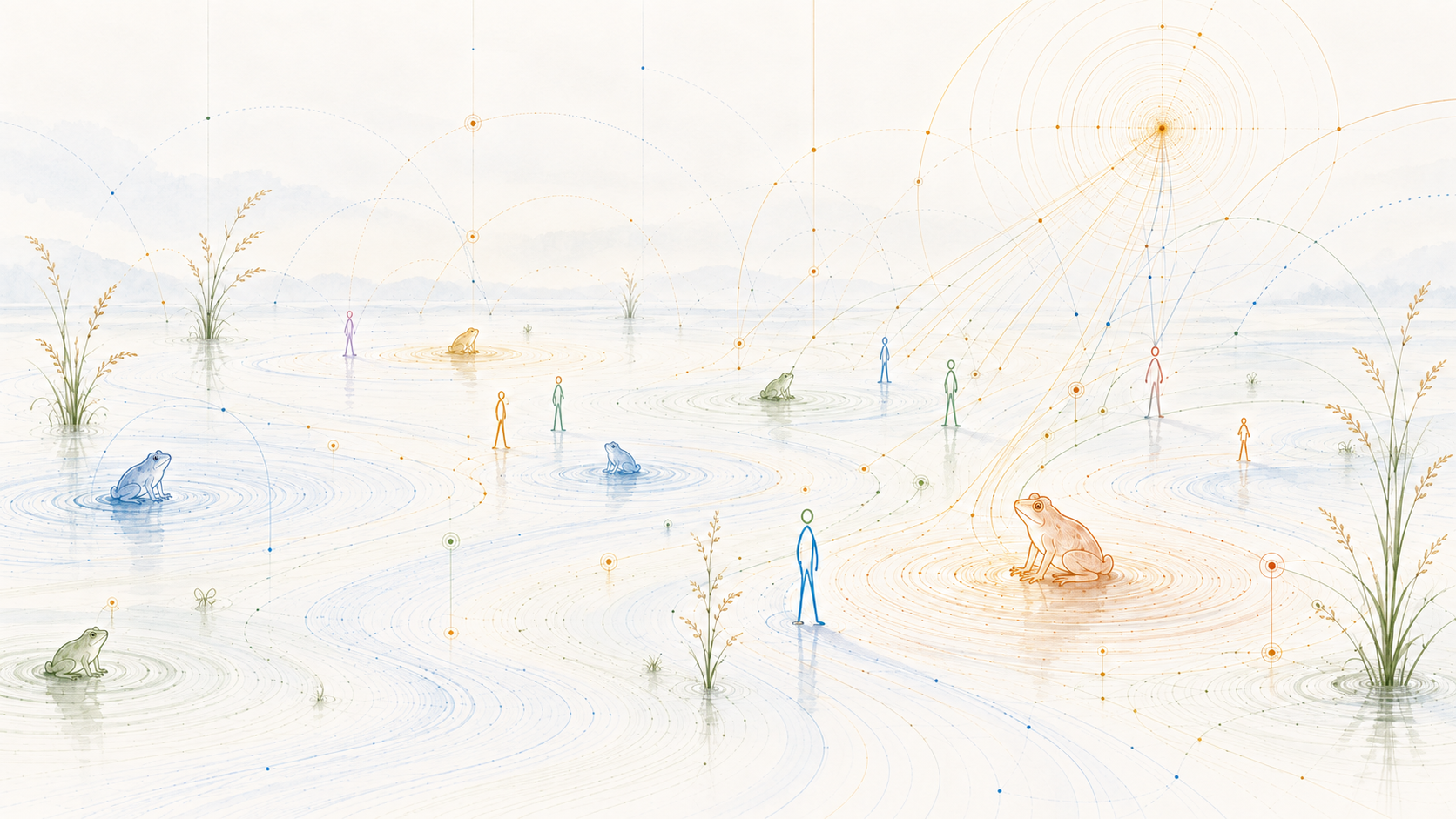
His house was surrounded by rice fields. In summer, especially at night, the croaking of countless frogs made the place loud — a noise you simply get used to near rice fields in Japan. As autumn sets in, the frogs fall silent and remain so throughout the winter.
I was visiting him on a sunny day in winter and we were talking in his living room. Well into the conversation, I suddenly became aware that I was hearing the unmistakable sound of countless frogs croaking, just as they do in summer. What on earth was going on?
It took me a few moments to figure out that this was a prank. He had recorded the frogs in the summer. When I arrived in the living room, he had started to play the recording at very low volume, gradually turning it up, just a little at a time, as we talked.
One thing that strikes me is how much was contained in that small moment. My friend, who was also a university teacher, was being playful. As teachers, we expect ourselves to be systematic, serious about content and generally conscientious in order to help our students to become more competent within our subject. If there is room within all that for play, for us to be who we are as human beings, then we are inviting something which is not normally part of the curriculum: enjoyment of the moment, consciousness of this moment of life. The living curriculum.
Another intriguing aspect of this: at the moment when I realised I was hearing the frogs, I also realised I had been partly aware of it for some time. It took me a while, in other words, to notice what I was noticing. Or perhaps I should say: it took me a while to notice that I was noticing.
Moments of awakening like this are the stuff of real learning. One of my tutors at Oxford was a very distinguished scholar in his sixties, a kind man, patient with me, not intimidating, able to express criticism without putting me down. I did not learn that much from him in terms of subject matter, but his kindness, patience, and non-judgemental approach is something I remember. And there was one moment when he did something that became, for me, an important moment of learning. I was reading aloud to him an essay I had written on a piece of seventeenth-century satire. He realised I had not really thought about what satire actually is. He did not say that. He simply took out a beautiful old dictionary, a huge book, and we looked up the word. The definition included the phrase "humorous invective." That moment has stayed with me. He had simply awakened me to the need to be conscious of the words I am using.
There are signs everywhere that something is already afoot, and education has not yet caught up with it. Despite the negativity, individuals are waking up — to life, to themselves, to what is possible. The systems we have built are not the problem. We do not need to tear them down. We need to see them differently and, in doing so, bring them to life.
The croaking has begun. It is real, not recorded. Most of us have not yet noticed that we are hearing it.