The Russell-Einstein Manifesto
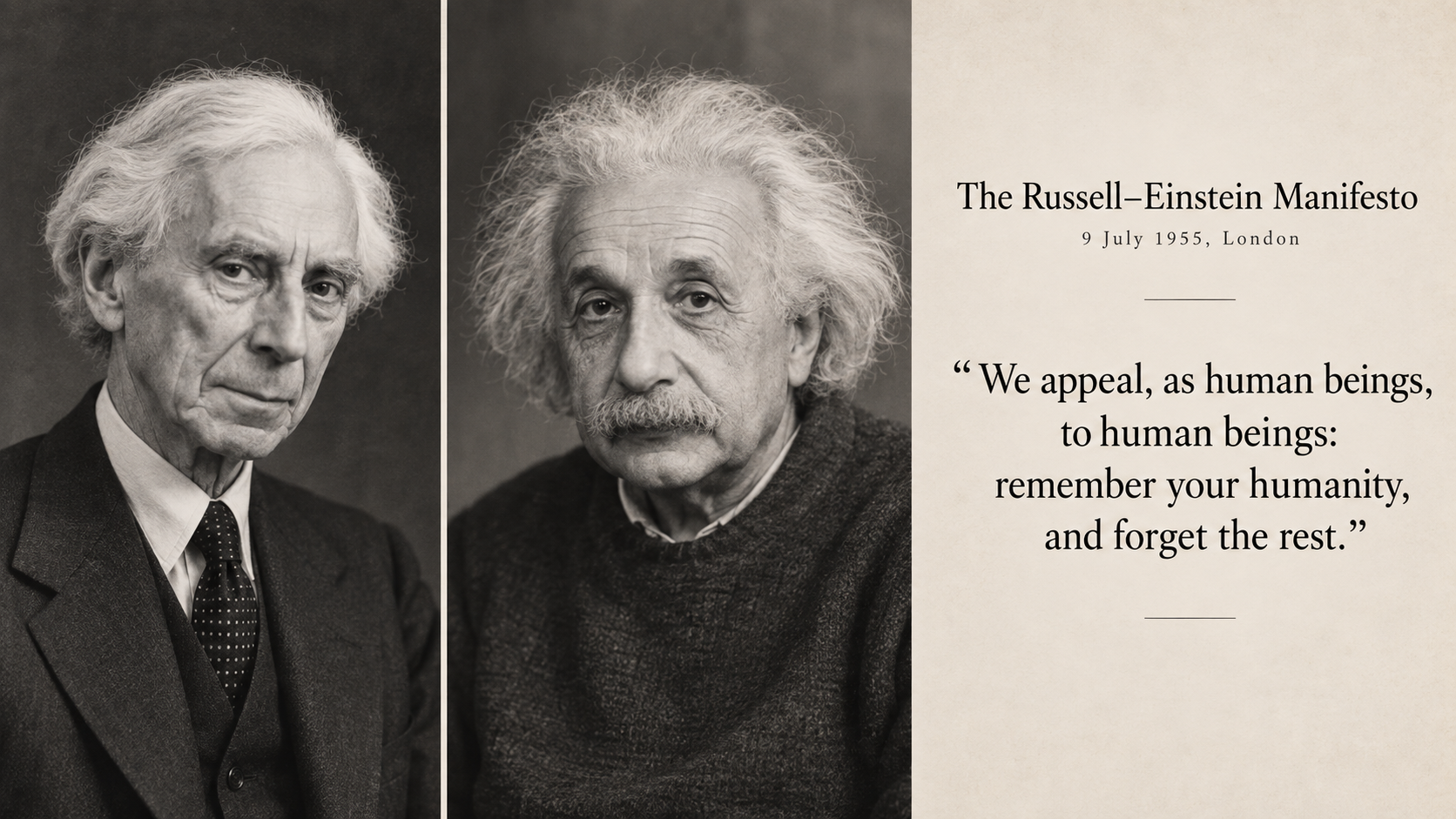
The Russell–Einstein Manifesto was released in London on 9 July 1955, signed by Bertrand Russell and ten other scientists, among them Einstein, Max Born, Linus Pauling and Hideki Yukawa — Einstein's signature came days before his death and was among the last public acts of his life. Written at the height of the hydrogen bomb era, the manifesto warned that the accumulation of nuclear weapons had put the continuation of the human species itself in question, and called for a conference to weigh the danger and press for its resolution. That call produced the Pugwash Conferences. Its closing appeal, addressed past governments to ordinary people, reads: "We appeal, as human beings, to human beings: remember your humanity, and forget the rest."
Russell and Einstein offered no argument for that appeal. They did not reason their way to what humanity required of the reader. They assumed it is already known, and asked only that it be remembered. Remembering is possible only where something was there to begin with. The same assumption carries the practical part of the appeal: the call to work together rests on a "we" the manifesto never argues for, and treats as older than the divisions cooperation has to survive.
The Living Curriculum Architecture handles dignity the same way. Dignity is not defined in the architecture and will not be. An understanding of it is meant to emerge across the writing rather than be fixed at the start, for the reason Russell and Einstein did not argue for humanity: some terms are recognised rather than proved.
Education has trouble with terms of that kind. Once a school sets out the human qualities it hopes to nurture, and empathy is near the top of most such lists, empathy becomes a thing to be delivered and assessed. But empathy is not a component of an educational ecosystem. It is a condition of one. Kindness and generosity hold the ecosystem together; they are not items inside it, and a school that lacks them will not acquire them by adding a line to a list.
That is what the manifesto assumes about humanity. It is not one of the things being built but rather what the building rests on.