
Revisiting a 1988 Book Review
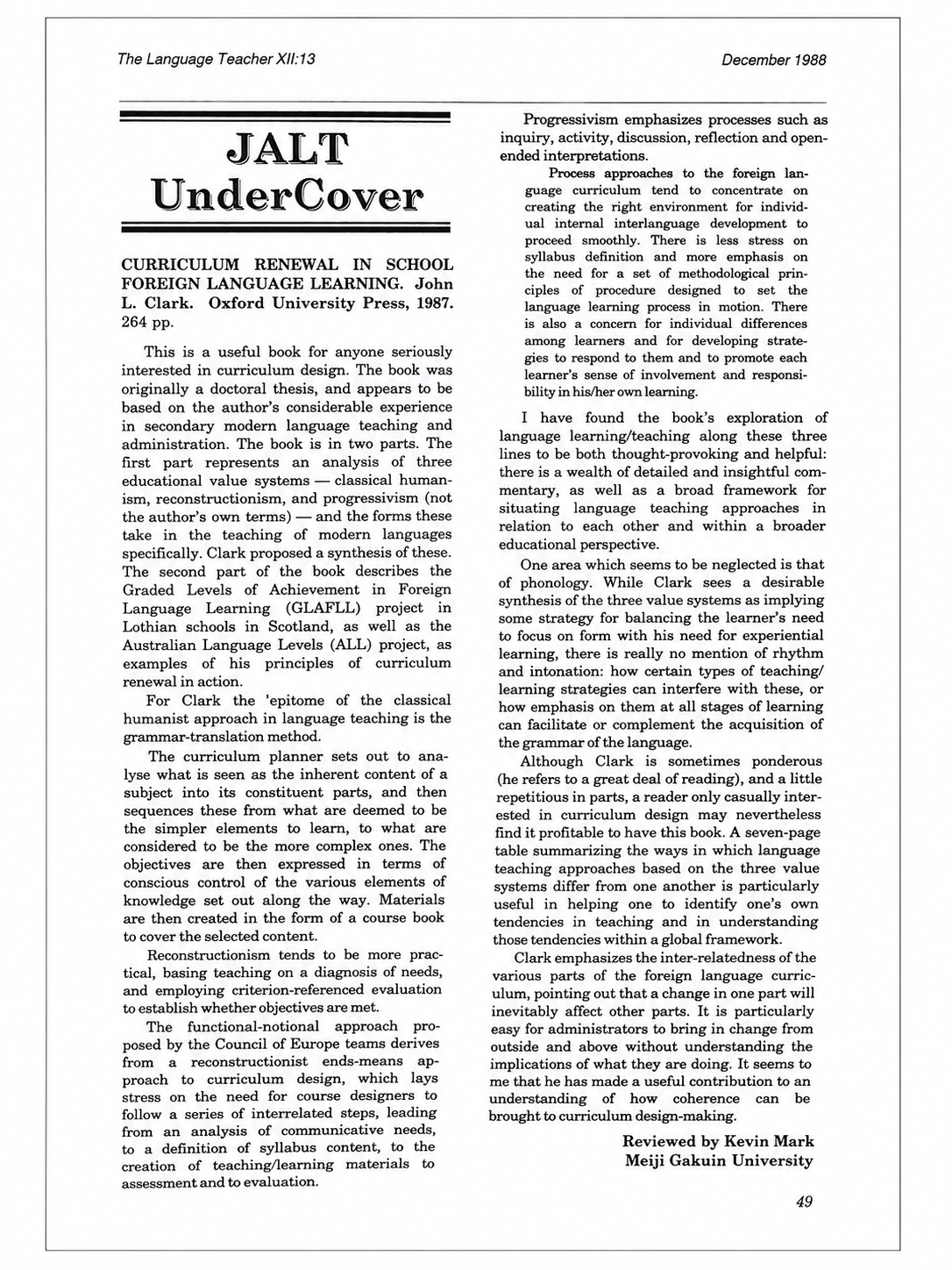
What I sought then was a broad picture that would help me understand how to approach teaching at the level of the smallest detail. I wanted whatever I was doing in the smallest things to be justifiable, and consistent with what I understood theoretically at the macro level.
The book I was reviewing was written for curriculum planners, not for ordinary teachers. I was an ordinary teacher, but I couldn't see why it wouldn't be possible for my mind to run both ways at once. There has always been a tension in my work between the wide view and the close one: between the whole person, Dewey's notion of experience, the shape of an entire curriculum, and the granular reality of what actually happens between a teacher and a learner in a single moment.
Over the next thirty-five years or so, I went a long way down into the close view, from several directions at once. I was early to a number of things. I wrote some of the first papers on the need for learner corpus data, and showed how it could improve language education — though I left the sophisticated software to the corpus linguists who were far better at it than I was. I wrote, early, about global issues in language education. I was teaching in the newly created Faculty of International Studies, where I could see an obvious need for global-issues content. For me the word "global" was doing double duty. On the one hand it referred to issues of conflict, human rights, the environment and poverty and how they are interconnected. On the other hand it carried for me the meaning of "holistic education" – how the whole person needs to be addressed within education and how the individual is related to the state of the world as a whole.
And I went deep into the design of self-study materials — including a self-study software platform called LexiSuite that I put years, and my own money, into building. I believed that working practical exemplars would make it much easier for people to understand the possibilities I saw than theory, research or discussion could. If people could not follow the idea in the abstract, they needed artefacts that embodied it — actual materials they could see in use, with the principles built in.
In none of these was I quite a specialist of the specialism. Through each I was reaching toward the whole. At the same time I was sitting on committees, watching curriculum decisions get made with no map at all, beyond the conventional one that had guided Japanese university English education for years. The answer to every problem was additive — more native-speaker classes, more speaking classes, more classes with smaller numbers of students and so on. Not that these ideas were without sense, but without a coherent and systemic approach their effect was inevitably superficial and piecemeal.
That is the reason for the map that sits at the centre of this site. It is an attempt to hold the wide view and the detailed views together — to keep the whole person in sight at the altitude of the curriculum and even down to the use of a single word. I thought and wrote about micro issues such as the extent to which Japanese learners of English tend to underuse sentences beginning with "I don't think," as in "I don't think he is coming" and designed study materials that would help learners to notice such tendencies for themselves rather than have to learn them as stated facts.
The need for an educational map is the thread running through the JALT series I have published here, where I read a recent issue of the journal cover to cover and showed how different specialisms are reaching to articulate the broad educational import they embody, but do not have the language or the map with which to do so.