
Listening as the field of language teaching speaks to itself - 1

Editorial · Hu & Hashim · Ellis · Machida
Reviews of Reviews · 1 · 2 · 3 · 4 · Roundup
I have been a member of The Japan Association for Language Teaching — JALT —for many years, but for the last four I have barely opened the journal or the monthly magazine. That is not a criticism of either. My teaching practice has never been led by academic writing. Over forty years I have used the literature when it corroborated what experience had already shown me, but experience always came first.
The last four years have been a time to look at my own work and ask how I can now integrate it into a coherent whole. I am retired, not under pressure to publish and not looking for a new position. What I have is something I want to share: thirty-one years teaching at Meiji University, in a specific institutional context, doing something that I think is genuinely unusual educationally — and only now in a position to articulate it as a whole that may actually be useful to other people.
Part of what sharpened that articulation came from an unexpected direction. From November 2024 until the beginning of April 2026 I taught a fifteen-year-old girl — a school refuser who wanted English lessons — once a week on Zoom. I call her KK. She has since entered a boarding school, an unusually liberal and tolerant one, and as far as I can tell she is doing fine. Teaching her turned out to raise exactly the same questions as forty years of university teaching: what does it actually mean to help someone learn, and what gets in the way? Seeing the same issues at two such different scales — a school refuser on Zoom and lecture courses at a major Japanese university — helped to bring my long experience and thinking about education into focus.
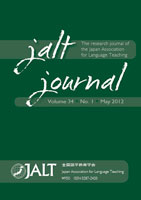
It was from that position that I decided, finally, to look outward at what the field is doing. Not as a literature search, and not because I felt I had been missing something. I wanted to see what the field looks like from where I am now standing — what shape it has, what assumptions it operates inside, what questions it asks and does not ask. I picked up the most recent issue of JALT Journal — volume 48, number 1, May 2026 — and decided to read it the way I do not normally read journals: in order, cover to cover, paying attention not to what each piece contributes to a literature but to what the whole reveals about the world the writers share. I wanted to listen to the field speak to itself.
This is the first of a series. There are 10 posts in all — one for the editorial pages, one for each of the three research articles, one for each of the four book reviews and a post summarizing the whole series in note form.
Unexpectedly interesting
I am not usually a sequential reader. I dip, I skip, I go looking for what connects with what I am already thinking. For this reading I deliberately set that habit aside. I wanted to go through the journal in order, not looking for what was useful to me, but staying with whatever came next. So I started at the beginning, with the editorial introduction, which I would normally have skipped entirely and not expected to find interesting.
Editorial introductions are where a field speaks to itself. They introduce articles that are careful — peer-reviewed, hedged, positioned within the literature, written in awareness of being read critically. The editors themselves work under less of that pressure. They address their readership as members of the same community, and they write with the assumption of shared values. Reading this section carefully, much more carefully than I usually would, proved more interesting than I expected.
One word: advocating
The first thing that stopped me was a single word. The editors describe the main articles in the issue as
advocating the importance of language education, education in general, and calling for dynamic approaches to teaching and learning to meet the challenges of language education in diverse settings.
Not identifying. Not exploring. Not examining. Advocating. I paused over the word. A medical journal does not advocate the importance of medicine. A legal journal does not advocate the importance of law. These fields do not need to make the case for their own existence to their own members; the case is settled. The fact that a language education journal felt the need to advocate for the importance of its own subject — to its own readership, in its own pages — was the first signal that something interesting might be happening beneath the surface. And there was also the term "dynamic approaches." The editors seem to be subtly asserting that the journal is showing a field in a process of constant change and growth.
Language education and education in general
What was the advocacy for? Language education and education in general, the editors said. And here I had to stop again, because that pairing — language education and education in general — is not a pairing I had seen made so directly in the field's own voice. My own work, across forty years, has been precisely about that relationship: what language teaching shares with education as such, and what gets lost when the field treats itself as a technical specialism rather than as a form of human development. To see the editors reach for that pairing, almost in passing, as if it were obvious — and then not develop it, not examine it, just name it and move on — was the clearest early sign of what I came to think of as the field's hidden educational inclination.
Perspectives, Expositions, and other categories
I noticed something else about the editorial pages, which was more structural. The articles in this issue are grouped under category labels — Perspectives and Expositions — and I realised, looking at them, that I had never quite understood the categories. I checked an older issue of the journal: November 2023. That one also uses Perspectives and Expositions, though folded inside a general "Articles" heading. I checked another: May 2025. That one uses Articles, Research Forum, and Reviews. There seems to be a working taxonomy in the field — research articles versus perspective pieces versus exposition pieces versus forum pieces — and these distinctions presumably mean something to the editors and to working researchers in the discipline.
They have never meant much to me. I have been a member of JALT for many years, and the categories have passed me by without much navigational use. That in itself is worth noticing. Why does the field feel the need for these distinctions? What work do they do? Whom do they help, and how? The question raises itself; I do not answer it here. But I notice that the apparatus of categorisation is one of the things a field develops to organise its own activity to itself, and the categorisation is not always legible from outside the small group for whom it is meaningful. That is a feature of how disciplines work, not a fault — but it does mean that what looks like organisation from inside can look like opacity from outside.
Four books, one frame
The last thing I read in the editorial pages was the editors' summaries of the four book reviews — the short paragraphs in the "In This Issue" section that describe what each reviewed book is about and why it matters. I did not read the reviews themselves, only these summaries.
The four summaries, taken together, named the books' subjects as: social justice and language education, antisocial language teaching, the professionalisation of English language teaching, and intercultural business communication. Each summary was competent. Each book, by any reasonable measure, sounded like a serious contribution to the field. And yet reading the four summaries consecutively, as a cluster rather than individually, produced a distinct impression: this is a field doing more and more things inside a frame it is not examining. Social justice added to language teaching. Professionalisation added to language teaching. Intercultural competence added to language teaching. Each addition is genuine, each addresses a real concern, and none of them touches the frame itself — the underlying model of what teaching is, what learning is, what the relationship between teacher and learner is for.
This is the pattern I have come to think of as additive reform: the field's default response to any recognised inadequacy is to add something. Add content, add a perspective, add a category of concern. What does not happen is the prior question: is the model we are adding to the right model in the first place? That question is not available from inside the frame. The four summaries, read as a cluster, made the pattern visible in its most concentrated form: four books, four additions, no examination of what is being added to.
Fifteen minutes
By the time I finished the editorial pages — probably fifteen minutes of reading and note making — I had more to think about than I had expected. The field was reaching toward something it could not quite name. The categories the editors used to organise their work were not obviously legible from outside. The book summaries had hinted at an unexpected commonality — a field operating on addition rather than on self-awareness or self-critique. And a single word — advocating — had revealed, almost accidentally, that the field was not as settled about its own value as a field might be expected to be.
I had not yet read a single research article.