
Listening as the field of language teaching speaks to itself - 4
Editorial · Hu & Hashim · Ellis · Machida
Reviews of Reviews · 1 · 2 · 3 · 4 · Roundup
認知言語学から見た生成AIと外国語学習 — 町田章
The English title of this article by Akira Machida is Generative AI and foreign language learning from a cognitive linguistics perspective
The article is in Japanese, which is noteworthy in itself. JALT Journal publishes in both languages and has done so for many years, but the bilingualism is not symmetrical. Articles appear in Japanese; book reviews do not. The field's ongoing critical conversation — the place where current books are read, evaluated, and located — happens in English. Japanese contributions appear at the level of original research and exposition, but not at the level of commentary.
Machida's argument in brief
Machida's argument has two parts. His starting point is that AI has changed the terms of the debate about foreign language learning: if a machine can handle most communicative needs, why learn the language at all? Now that AI is here, the communicative case for foreign language learning has weakened. The case he wants to make is different. Foreign language learning gives the learner access to another community's habitual ways of attending to the world — 慣習的な世界の捉え方, habitual in his Japanese — and that, he argues, is a cognitive and educational good that AI cannot replace. His defence of this claim draws on the technical vocabulary of cognitive linguistics, particularly the concept of construal — the idea that different languages do not merely label the same world differently but organise attention to it differently. His case rests on what foreign language learning offers the learner, not on communicative utility.
One word in his English abstract reaches beyond that vocabulary. His Japanese says 慣習的な — habitual, conventional, patterns taken for granted. His English abstract says sedimented: culturally and historically sedimented patterns of categorization, profiling, and perspective taking. Where habitual describes the patterns as they appear, sedimented points to what underlies them: layers that accumulate in the individual through culture, without their knowing it, no longer visible to them from the inside. That is his word, reaching toward something his cognitive linguistics frame is not equipped to develop.
What Machida is pointing toward, without quite naming it, is the need for an individual to become conscious of what has been unconsciously absorbed — to see the conditioning that has become the structure of their perception. That is an educational question — and whether foreign language lessons are how it gets answered is not where sedimented points. This reading is going to explore in depth what sedimented is pointing toward.
That is the argument as Machida presents it. The title names the frame: cognitive linguistics, generative AI, foreign language learning. The argument underneath is a defence of foreign language learning in the age of AI. The frame and the argument are not the same thing, and the distance between them is where this reading begins.
The editors of this issue say the articles combine into a narrative — their word — "calling for dynamic approaches to teaching and learning to meet the challenges of language education in diverse settings." They are sensing something unfolding across the articles. In Machida's case, what is unfolding surfaces in a single word. The concept of sedimentation — the unconscious absorption of culturally and historically compacted patterns, invisible to the individual standing inside them — is a seed, almost entirely buried in the article. That is not a limitation of Machida's insight. The cognitive linguistics ecology in which this seed has been planted is not the soil in which it can grow.
The patterns that sedimented names are not merely different ways of organising perception. They have been absorbed from the environment, taken on without the individual knowing how or when, invisible precisely because they have become the structure through which the individual sees. That is not primarily a cognitive linguistics point. It is an educational one — and education that stays at the level of the system, without reaching the individual, can process but cannot enliven.
Academic reviews of journal articles do not normally include cartoons. This one does. Machida is reaching out to language teachers. This is a language teacher's response. A response does not have to be in the same language as the question — and in this case, cannot be, if it is going to reach the territory his argument is pointing toward. His language is cognitive linguistics. The territory he is pointing toward is the individual's own aliveness, progressively enclosed by unconscious conditioning until it can no longer be felt from within. That territory cannot be shown in the language of construal and structured inventories. It can be shown in a cartoon.
The image below is from Fighting for Freedom (World Studies Series, Nelson, 1978, copyright World Council of Churches). It shows what sedimentation looks like as a human process — shown as a series of images rather than described.
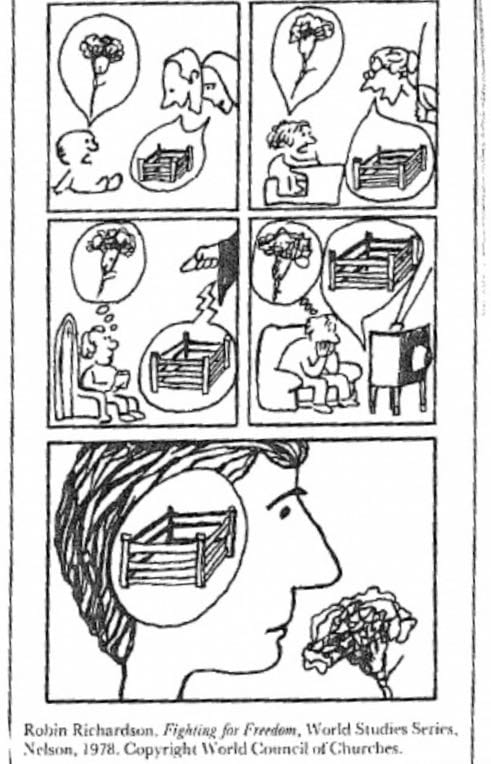
In the first panel, an infant sits with its parents. The infant's speech bubble contains a flower — the child expressing and enjoying its own inner nature, directly and without filtering. The parents smile, but their speech bubble contains a playpen. They are not hostile; they are loving. The child speaks from its natural condition; the adults answer with containment.
In the second panel, the child sits at a school desk facing a teacher. The flower is still in the child's speech bubble — the child can still say it, still express something of its own inner nature. The teacher's response is again the playpen. The setting has changed from home to school, but the message is continuous.
In the third panel, the child sits in a church pew. The flower has not disappeared, but it has retreated into a thought bubble. What could once be spoken has become private. From the pulpit, a stern pointing hand delivers a jagged speech bubble — the playpen, now as moral command.
In the fourth panel, a young man sits alone in front of a television, looking unhappy. The flower persists, but only in thought. The television speaks only of the playpen. Family, school, religion, and media have all delivered the same message.
In the fifth and largest panel, the process is complete. An adult head is shown in profile. Inside his head, there is a playpen. Outside stands a real rose — not a speech bubble, not a thought bubble, but a rose present in the world. The individual has internalised the playpen so completely that even the flower, right there in front of him, can only be experienced through the conditioning lens of the playpen. The aliveness is still in the world. His own aliveness has been diminished. The rose is present; he cannot meet it without the filtering of what he has absorbed.
The cartoon's images are of their time and of their culture — the playpen, the church, the television screen are Western symbols of containment and moral authority. The structure they illustrate is not Western. It is what every culture does, through its own institutions and its own symbols.
A contemporary Japanese version, made with AI for this piece, makes the same argument in different images. The institutions are different.
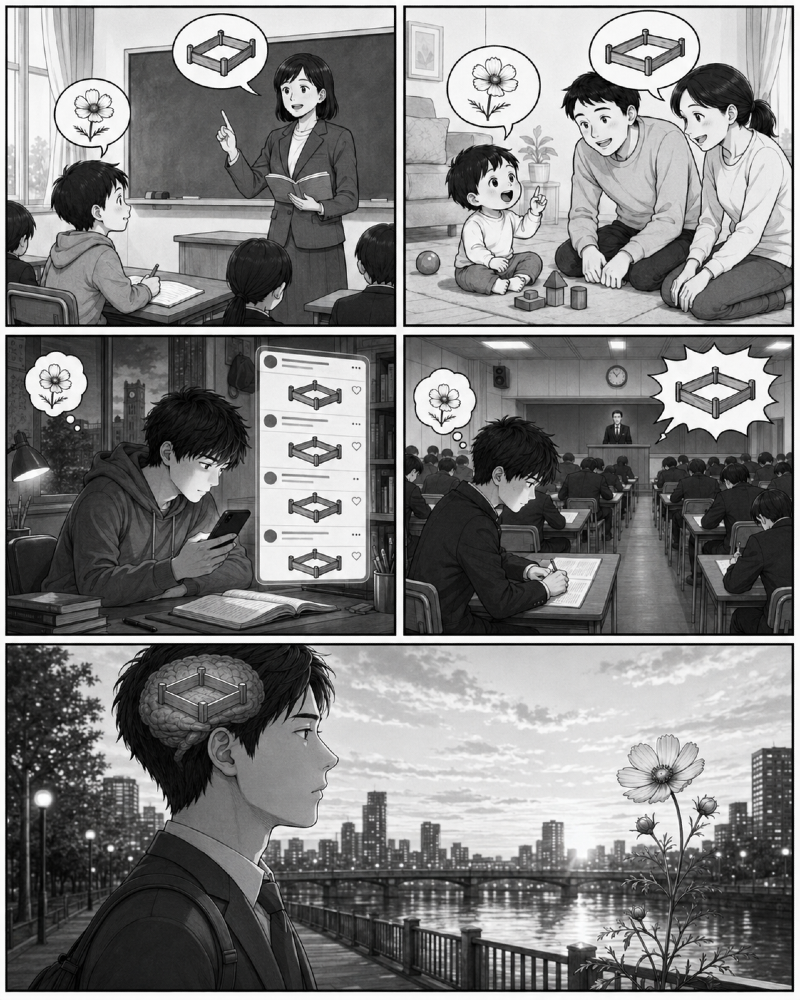
In the first panel, an infant sits with his parents in a Japanese home, as in the original cartoon. The infant's speech bubble contains a flower. His parents' speech bubble contains a playpen.
In the second panel, the setting has changed from home to school, but the message has not. The flower is still in the child's speech bubble. The teacher's response is again the playpen.
In the third panel, the student sits in a university entrance examination hall. The flower has retreated into a thought bubble — it can no longer be said aloud. The entire situation expresses the playpen message.
In the fourth panel, the young man sits alone with his smartphone. The social media feed fills the screen — and every item in the feed is a playpen. The flower persists, but only in thought.
In the fifth and largest panel, the child has become a successful salaryman in the city. Having fully internalised the playpen, he does not know that he longs to feel the freedom of the flower within himself.
If the cartoon shows sedimentation as enclosure, the educational question is not how to describe that enclosure, but under what conditions a learner can begin to notice it.
Students can feel enlivened when they catch sight of their own conditioning — what has been accumulating in them unconsciously, absorbed without their knowing it. But that seeing does not happen on demand, and it does not happen in a climate of judgement or performance pressure. It happens when unnecessary constraints are removed, when the individual has room to be themselves, when the conditions of learning are free enough for something unexpected to occur. Foreign language classes, like any class, can be places where that becomes possible. When the conditioning becomes visible, even for a moment, there is a choice: to sink back into it, or to begin thinking from outside it. With that choice comes the possibility of being more fully oneself.
Machida's article does not develop this further. What follows goes beyond his article — invited by the insight his word sedimented carries beyond his own cognitive linguistics frame. Journals are at their best when they are places of open exploration and genuine, respectful dialogue — dynamic, to use the editors' word. In that spirit, this response follows where sedimented points, into territory that is my own.
The conditions are not a method. They are what happens when both teacher and student are free to be whole people within their roles — when role and whole person are held together, with dignity, on both sides. In those conditions, a quality of presence emerges: the noticing of what is actually happening, the awareness of choices between how one is operating and how one might choose to operate.
A single classroom moment shows the conditions more directly than any further description.
A student has assumed what the teacher wants him to say and is sitting tensely, trying to produce it. The teacher says you're looking very tense. The sentence is a mirror. The student sees what he has been doing — the assumption, the trying-to-please, the contortion — and something shifts because he has seen it. This is not a technique. It cannot be lifted from one classroom and applied in another. It happened because the conditions were right: a teacher present enough to notice, a student with enough room to be seen without judgement.
An educational approach that understands the value of moments like these does not try to produce them. It creates the conditions in which they are more likely to occur.
Machida's article is conscientiously made and seriously intended. It reaches, through one crucial word, toward an educational question the field of language teaching is not yet asking directly: what can language learning open up in the individual — not just linguistically, but as a person? His cognitive linguistics frame cannot carry that question to its destination, because it is built to describe cognitive operations, not to ask what happens to the individual as a whole person — over time, through lived experience, in relation to others. But the word sedimented — used once, in an abstract, and left undeveloped — is evidence that the question is present in his thinking, waiting for a different language to give it room.